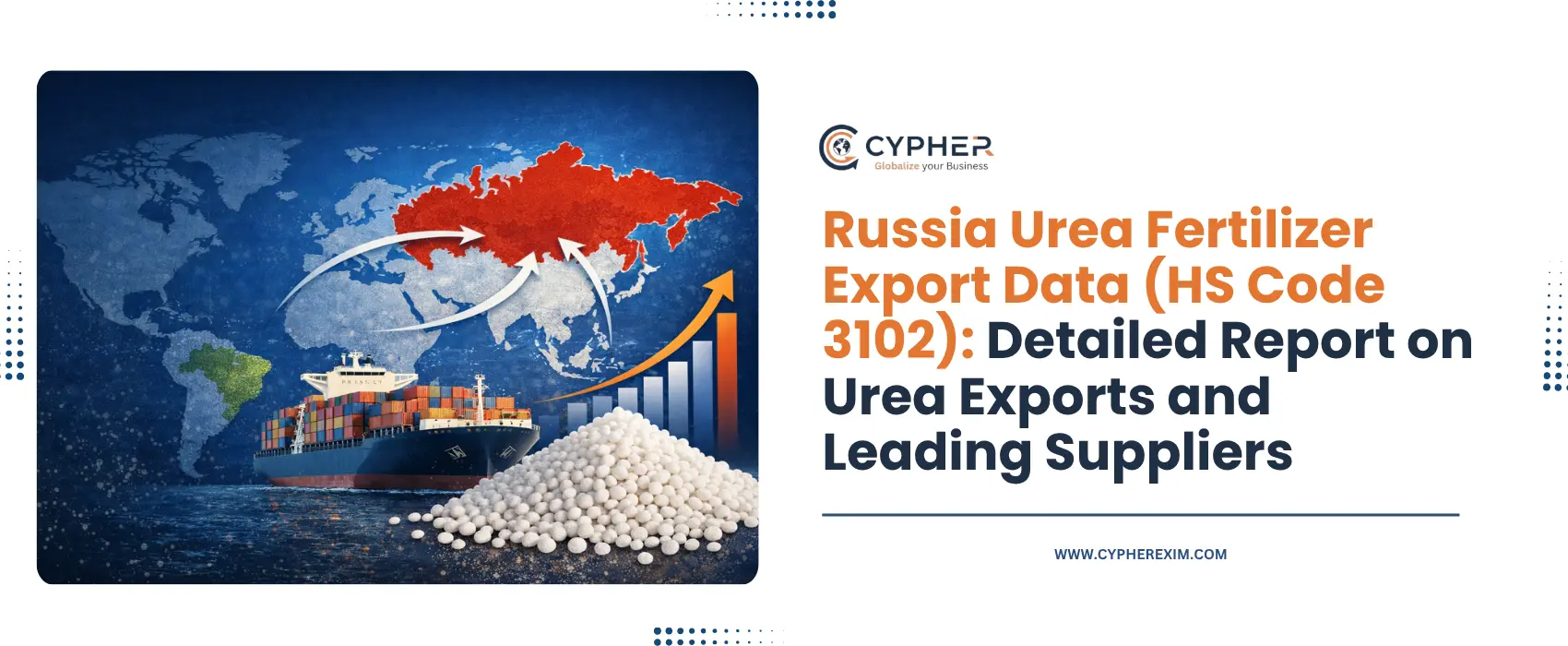
Russia Urea Fertilizer Export (HS Code 3102): Detailed Report on Urea Exports and Leading Suppliers
20 Mar 2026
Urea (HS Code 310210), classified under the broader HS Code 3102 category for nitrogenous fertilizers, remains one of the most critical agricultural commodities in international trade. Russia is consistently ranked among the leading exporters of nitrogen-based fertilizers worldwide, with urea representing a significant portion of its fertilizer export portfolio. Based on the latest Russia export reports and customs shipment records, the total value of Russia’s urea exports reached approximately $3.65 billion in 2025, reflecting a modest 1% increase compared to the previous year.
In terms of volume, Russian urea exports in 2024 were estimated at around 9.5–9.8 million metric tons (MMT). Early projections for 2025 indicate that shipments could potentially exceed 10.5 MMT if the current export momentum continues. Even with ongoing geopolitical challenges, tariff changes in Europe, and shifts in global trade routes, Russian fertilizer producers have successfully maintained—and in several markets expanded—their global presence. Urea remains the most widely used nitrogen fertilizer globally, serving as an essential input for agricultural production across crops ranging from grains to horticultural products. According to global trade statistics, Russia continues to be the largest exporter of urea worldwide.
With vast natural gas reserves and a well-developed chemical manufacturing industry, Russia plays a crucial role in the global production and supply of urea and other nitrogenous fertilizers. This 2024–2025 analysis of Russian fertilizer exports under HS Code 3102 provides an overview of actual shipment reports, key export destinations, supply chain trends, leading fertilizer exporters, regulatory and geopolitical influences, and the broader implications for international agricultural markets.
Russia’s Dominance in the Global Urea Export Industry
Russia has consistently maintained a strong position as one of the world’s leading exporters of urea and other nitrogen-based fertilizers. According to global trade statistics, Russia remains a major supplier in the international fertilizer market, particularly under HS Code 3102, which covers nitrogenous fertilizers including urea. In 2024, the country recorded total exports of nitrogen fertilizers worth approximately $4.95 billion, highlighting its significant contribution to global agricultural supply chains. Historical customs shipment reports also show that Russia exports millions of tonnes of urea each year to key agricultural regions around the world, supporting crop production in both developed and emerging economies.
In terms of export volume, industry reports indicate that Russia exported roughly 9.7 million tons of urea in 2024, demonstrating steady growth compared to previous years. The value of Russia’s urea exports is estimated to have reached around $3.6 billion in 2025, reflecting sustained global demand for nitrogen fertilizers. This growth in export value is closely linked to broader trends in the global fertilizer market, where prices often fluctuate due to factors such as natural gas costs, geopolitical developments, trade policies, and supply chain disruptions. Since natural gas is a primary input in urea production, changes in energy prices can significantly impact fertilizer pricing and export revenues.
Additionally, Russia’s fertilizer export policy includes quota systems and regulatory controls designed to maintain a balance between domestic agricultural needs and international market opportunities. These measures help stabilize local fertilizer availability while allowing Russian producers to remain competitive in global markets. Overall, the scale of Russia’s fertilizer shipments means the country frequently accounts for a double-digit share of global nitrogen fertilizer exports, reinforcing its strategic importance in the international urea trade and global food production systems.
Understanding HS Code 3102: Urea in Global Trade
HS Code 3102 covers mineral or chemical nitrogenous fertilizers, which include urea and various urea-based fertilizer blends widely used in global agriculture. Within this classification, there are several important sub-categories that help identify specific fertilizer types in international trade records. For example, HS Code 310210 refers specifically to urea in solid form, which is the most commonly traded nitrogen fertilizer worldwide. Another classification, HS Code 310220, includes other nitrogen-based fertilizers, such as mixtures containing urea, ammonium nitrate, and urea ammonium nitrate (UAN) solutions. Additional codes like HS 310230, 310240, and related categories cover other complex nitrogen fertilizer formulations used for different agricultural applications. In global export reporting and customs reportsbases, HS Code 310210 for urea is the most frequently monitored category because urea represents the largest share of international nitrogen fertilizer trade and is a key commodity in global agricultural supply chains.
Major Importers of Russian Urea Fertilizer Worldwide
Russia plays a major role in the global urea fertilizer market, exporting large volumes to agricultural economies across multiple regions. Its export network is geographically diverse, allowing Russian fertilizer producers to supply both developed and emerging markets. According to Russia shipment reports and urea export statistics for 2025, several countries stand out as the primary destinations for Russian urea fertilizer. Brazil is the largest importer, purchasing around $836 million worth of urea, which accounts for roughly 17% of Russia’s total exports. Brazil’s large-scale farming industry relies heavily on imported fertilizers to sustain crop production and support its vast agricultural lands.
The United States is another key market, importing approximately $761 million (15%) of Russian urea exports. Demand in the United States is driven by its extensive agricultural sector, where fertilizers are essential for maintaining high crop yields. India also represents a significant destination, accounting for about $537 million (11%) of Russia’s urea shipments, as the country depends on fertilizer imports to enhance soil fertility and increase agricultural productivity. Meanwhile, Turkey imports around $420 million (9%), using the fertilizer to support its diverse crop cultivation and strengthen food security.
European countries also represent an important share of Russia’s urea export market. The Netherlands imports roughly $350 million (7%), benefiting from its role as a major agricultural and logistics hub in Europe. Finland follows with approximately $330 million (7%), where fertilizers are essential for improving crop yields in challenging climatic conditions. In the Americas, Mexico imports about $300 million (6%), while Colombia accounts for $210 million (4%), both using imported fertilizers to strengthen agricultural output. Additionally, Germany purchases about $200 million (4%), and Belgium imports around $180 million (3.9%) of Russian urea. Together, these markets highlight Russia’s strong presence in the global fertilizer trade, where its exports support agricultural productivity and food supply chains across multiple continents.
Russia Urea Export Market: Leading Fertilizer Suppliers and Exporters
Russia’s urea export supply is largely dominated by a group of major integrated fertilizer producers and trading companies that operate extensive global distribution networks. According to the latest Russia urea suppliers reportsbase and exporter records for 2025, several large companies play a key role in supplying urea and other nitrogen-based fertilizers to international markets. Among the leading exporters is Uralchem, with an estimated export value of around $1.3 billion in 2025. The company primarily exports granular urea (HS 310210), prilled urea, and UAN solutions, with major markets including India, Brazil, and Turkey. Another significant player is EuroChem Group, which recorded approximately $1.1 billion in exports, supplying products such as granular urea, UAN, and ammonium nitrate to markets including Brazil, the European Union, and the United States.
Other major exporters include Acron Group, with around $850 million in exports focused on granular urea, ammonium nitrate, and NPK blends, primarily shipped to Europe, Brazil, and African markets. TogliattiAzot also plays an important role in the global fertilizer trade, exporting approximately $750 million worth of urea and ammonia derivatives to destinations such as Turkey, Europe, and India. Meanwhile, PhosAgro contributes around $450 million in exports, specializing in nitrogen blends, UAN, and specialty fertilizers mainly supplied to European and Latin American markets.
Additional exporters include KuibyshevAzot, exporting roughly $380 million in industrial urea and related nitrogen products to countries like Brazil and the United States, and Metafrax Group, which supplies about $320 million in industrial-grade urea and formaldehyde-linked products to Asian and Turkish markets. Other notable suppliers are Gazprom Neftekhim Salavat with approximately $280 million in exports of urea, ammonia, and nitrogen solutions; Shchekinoazot, exporting around $220 million in urea and methanol-linked nitrogen products mainly to Europe and CIS countries; and Minudobreniya Rossii, which ships about $120 million in bulk urea exports, largely serving markets in Africa and South Asia. Together, these companies form the backbone of Russia’s urea export industry, supplying large volumes of nitrogen fertilizers to agricultural markets worldwide.
Major Companies with Integrated Fertilizer Production
Several large integrated fertilizer producers form the backbone of Russia’s urea export industry. Companies such as Uralchem are recognized as leading nitrogen fertilizer manufacturers with significant urea production capacity and a strong presence in global markets. Another major player is Acron Group, which produces a wide range of nitrogen and complex fertilizers and operates an extensive trade and distribution infrastructure to support international exports. TogliattiAzot also plays an important role in the sector, as it is one of the world’s largest ammonia producers and is closely connected to large-scale urea production. In addition to these major corporations, export registry records show that numerous other companies participate in Russia’s fertilizer trade. Trade reports indicates that approximately 80–90 registered firms are actively involved in exporting urea in bulk, supplying international buyers across multiple agricultural markets worldwide.
Global Fertilizer Export Trading Companies
Export intermediaries and trading companies play an important role in the global distribution of Russian urea. Trading subsidiaries of major producers such as EuroChem Group, along with international commodity brokers, act as key distribution channels that facilitate shipments to major agricultural markets including the United States, South America, and Asia. These intermediaries help manage logistics, market access, and large-volume fertilizer transactions across global supply chains.
For importers and supply chain managers, it is essential to evaluate the operational capabilities, certifications, and reliability of these suppliers and trading partners. Factors such as product quality standards, shipping terms like CFR (Cost and Freight) or FOB (Free on Board), and compliance with international payment and trade regulations play a crucial role in ensuring smooth and secure fertilizer procurement.
Russia Urea Export Trends Over the Last 10 Years
Over the past decade, Russia’s urea export performance has shown steady growth, reflecting rising global demand for nitrogen fertilizers and fluctuations in fertilizer pricing. In 2015, Russia’s urea export value stood at around $1.28 billion, followed by a slight decline to $1.13 billion in 2016. The market recovered in 2017, reaching $1.27 billion, and continued to grow in 2018 and 2019, when exports were valued at approximately $1.58 billion and $1.64 billion, respectively. In 2020, export value slightly decreased to about $1.51 billion, largely influenced by global economic disruptions and changes in agricultural demand.
However, from 2021 onward, Russia’s urea export value increased significantly, largely driven by rising fertilizer prices and strong international demand. Exports reached about $2.48 billion in 2021 and further climbed to $2.95 billion in 2022. The upward trend continued with exports valued at approximately $3.12 billion in 2023 and $3.40 billion in 2024. By 2025, Russia’s urea export value is estimated to have reached around $3.65 billion, highlighting the country’s growing influence in the global nitrogen fertilizer market and its continued role as one of the world’s leading urea exporters.
Sanctions, Tariffs, and Regulations in the Global Urea Export Market
Russian fertilizer exports have evolved within a complex landscape shaped by geopolitical developments, trade regulations, and domestic policy measures. Although most Western sanctions have not directly targeted fertilizer products, trade barriers such as tariffs and anti-dumping duties—particularly within the European Union—have created challenges for Russian exporters. Despite these restrictions, fertilizer imports into European markets have not significantly declined, largely because agriculture in many regions continues to depend heavily on stable fertilizer supplies. As a result, trade flows have persisted, demonstrating the strong demand for nitrogen fertilizers in global agricultural systems.
In addition to international trade pressures, Russia has implemented domestic policies aimed at balancing export growth with local supply stability. The government has periodically introduced export quota systems for nitrogen and compound fertilizers to ensure adequate availability for domestic farmers while still allowing producers to participate in global markets. These quota mechanisms can influence the timing, volume, and predictability of fertilizer shipments, which is an important factor for international buyers and supply chain planners.
Another critical factor affecting Russia’s fertilizer export competitiveness is the cost of energy. Since natural gas is a primary raw material used in urea production, fluctuations in gas prices directly impact fertilizer manufacturing costs. Russia benefits from relatively lower domestic natural gas prices, along with currency advantages such as a weaker ruble, which together help maintain the global competitiveness of Russian fertilizer exports compared with producers in other regions.
What Drives India’s Demand for Russian Urea Fertilizer
Demand for Russian urea in global markets is influenced by several important agricultural and economic factors, particularly in major importing regions. In India, fertilizer import patterns have increasingly shifted toward Russian suppliers. Agricultural trade reports shows a strong presence of Russian fertilizers in India’s imports, especially nitrogen, phosphate, and potash products. Long-term collaborations and joint ventures between Russian fertilizer producers and Indian companies have further strengthened this relationship, aiming to expand domestic fertilizer capacity and secure stable supply chains. India’s demand is primarily driven by the need to maintain crop yield stability, support national food security, and reduce dependence on traditional suppliers from the Middle East and other Asian markets.
In the United States, Russia has also become a major supplier of urea fertilizer, accounting for a significant share of total imports according to recent trade reports. The demand in the U.S. market is largely linked to the country’s large-scale agricultural sector, which requires consistent fertilizer supplies to sustain crop productivity. Across Europe, despite tariffs and geopolitical pressures, the demand for imported urea remains strong. This continued demand reflects the region’s structural reliance on fertilizer imports, particularly as domestic production capacity has declined in recent years. Meanwhile, regions such as Latin America and Africa are emerging as strategic growth markets for Russian urea exports. Competitive pricing, established trade networks, and efficient logistics make Russian fertilizer an attractive option for these regions, where local fertilizer production is often limited and agricultural demand continues to expand.
Industry Outlook and Strategic Implications for Urea Trade
The outlook for Russian urea exports remains positive as global demand for fertilizers continues to grow. Industry analysts expect export volumes to expand further through 2026 and the coming years, supported by strong agricultural demand, increasing production capacity, and Russia’s efforts to diversify its export markets. Major fertilizer companies such as Uralchem, EuroChem Group, and Acron Group have also expressed ambitions to strengthen their global presence. Russian producers collectively aim to capture around 25% of the global mineral fertilizer trade by 2030, reflecting a long-term strategy to expand market share and reinforce their position in international agricultural supply chains.
Pricing competitiveness is another key factor shaping the market outlook. Global fertilizer prices are often influenced by Russian export strategies, as suppliers frequently offer competitive shipping terms such as CIF (Cost, Insurance, and Freight) and CFR (Cost and Freight) to attract buyers beyond traditional markets. These pricing advantages, combined with relatively lower domestic energy costs, help Russian exporters remain competitive in the global fertilizer industry. However, the future trajectory of exports may also depend on policy developments, including potential tariff increases or expanded sanctions, which could redirect trade flows and encourage importers to diversify their supply sources.
For global importers—including agricultural corporations, government procurement agencies, and commodity traders—several supply chain considerations remain crucial when sourcing urea. Ensuring supplier reliability is essential, particularly given the influence of export quotas and regulatory policies that can affect shipment schedules. Effective trade planning is also important, involving port logistics, transshipment hubs, and seasonal fertilizer demand cycles. Additionally, buyers must carefully manage compliance risks, including tariff regulations, sanctions screening, and documentation requirements, to maintain smooth and secure international fertilizer transactions.
Important Takeaways for Fertilizer Importers and Trade Professionals
For fertilizer buyers and market stakeholders planning procurement strategies or long-term supply agreements, several key factors should be considered when sourcing urea from global markets. Russia continues to hold a strong position as one of the leading exporters of urea under HS Code 3102, with steadily increasing export volumes and a broad network of international destinations. Major import markets include India, European Union, and the United States, each operating under different regulatory frameworks, tariff structures, and trade policies that can influence procurement decisions.
The supplier landscape is also diverse, ranging from large vertically integrated chemical and fertilizer producers to smaller export-oriented trading companies. These suppliers often provide different contract terms, shipment volumes, pricing structures, and export arrangements, giving buyers multiple sourcing options. At the same time, the regulatory environment surrounding fertilizer trade continues to evolve, with tariffs, geopolitical developments, and policy changes potentially affecting trade costs and supply stability. Strong demand growth in agricultural regions across Asia and the Americas is further driving global urea imports, reinforcing the importance for buyers and supply chain planners to monitor trade trends, supplier reliability, and regulatory changes when making long-term procurement decisions.
Concluding Remarks and Market Outlook
Russia’s fertilizer export sector, particularly urea classified under HS Code 3102, highlights the country’s strong production capacity, deep integration with global markets, and the influence of changing demand patterns and policy conditions. Recent trade reports from 2024 to 2025 shows a steady increase in export volumes, along with stronger trade relationships with key agricultural regions across Asia, the Americas, and Europe. These trends demonstrate Russia’s continued importance as a major supplier of nitrogen fertilizers supporting global crop production.
For international agribusiness companies, policymakers, and supply chain planners, monitoring these export trends is increasingly important. Understanding the dynamics of fertilizer trade helps organizations plan procurement strategies more effectively while managing challenges such as geopolitical uncertainties, fertilizer price fluctuations, and the long-term need for global food security. As Russia continues to adjust its export strategies and strengthen partnerships with emerging and established markets, the fertilizer industry will remain a critical component of international agricultural trade and supply stability.
Reader Advisory Note
We hope this detailed overview of Russian urea exports under HS Code 3102 has provided valuable insights into global fertilizer trade trends. For readers seeking deeper market intelligence—such as Russia’s urea exports by country, HS code–level shipment analysis (including 310210, 310230, 310280), monthly trade patterns, or access to a verified reportsbase of Russian urea suppliers and exporters—Cypher Exim offers comprehensive solutions to support your research and business decisions.
With access to extensive Russia import–export shipment reports, company-level trade intelligence, port-wise shipment tracking, pricing benchmarks, and supplier verification tools, Cypher Exim helps businesses transform raw trade reports into actionable insights. These reports-driven solutions are designed to assist importers, exporters, and market analysts in optimizing procurement strategies and identifying new opportunities in the global fertilizer industry.
If you are interested in exploring sample reportssets, partnership opportunities, or customized trade intelligence reports, you can contact the Cypher Exim team at sales@cypherexim.com
to learn how reports-backed insights can strengthen your position in the international urea and nitrogen fertilizer market.
Disclaimer: The information in this report is provided for general informational purposes only and is based on publicly available trade reports, industry reports, and market estimates. While efforts have been made to ensure accuracy, reports may vary due to reporting updates or source differences. This content should not be considered financial, legal, or investment advice. Readers are encouraged to verify information independently before making business or trade decisions.